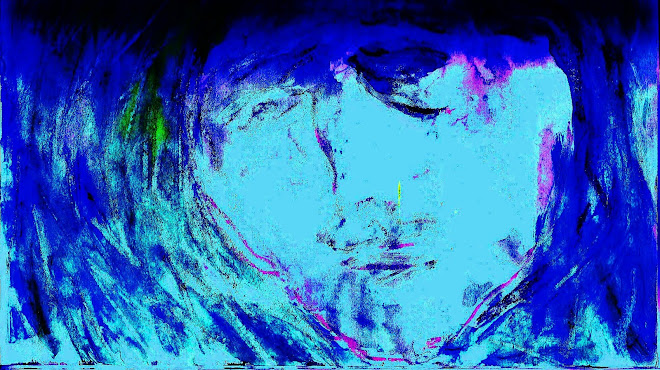
internal prisons cage us
cut from the same cloth
my self
your self
we all host a self
the water moves towards me
the dust of death hangs over
but in His life I hover new
all selves discarded
expanded by and into
supreme unity
~~~~~~~~~~~~~~~~~~~~~~~~
If God is in our every cell and experiences everything we experience (and as we are experiencing it), then Christ is God's mirror image, a multi-dimensional representation of a man who suffers as we do.
And if God is in our every cell, does that then mean we each are one of His cells and are therefore part of the totality of Him?
If He loves us, why would God want us to suffer? Why does suffering have to be a non-negotiable condition of His love?
We obsess, trying to figure out things and then control them. On some level, suffering is unnecessary. If our reaction to it is indeed in our control, then perhaps releasing into it is all there is to do. But fears govern us.
Why do we fear? Lack of trust in God? Lack of control over the known and unknown? Dislike of pain and suffering? If God is in our every cell, is there reason at all for us to fear?
Why do we need an answer to everything? Is it beyond our ability to perceive the answers to the higher questions?
Is the mystery of the Shroud God's way of telling us: “Look, you won't get the answers you seek in life, but hang in there because my unsolvable mystery on this cloth keeps you entertained for now and the mystery will eventually be resolved.” (Let's face it, mystery and suffering do keep us entertained – watch T.V. or go to the movies if you doubt that).
If God is in our every cell, why would He want Himself, His son and us to suffer? Is suffering a cleansing experience for Him? A purification of our toxic cellular anatomy before we can be fully unified into His supreme being?
Sharp machinery and physical forces begin the creation of beauty (wood carving, steel and bronze sculpting, marble and mineral polishing, phenomenon in nature, etc.). The beauty is revealed through the pain, just like the serene image on the Shroud is contextualized by Christ's Passion.
Why did He need to make pain into beauty? Why not just go straight to making the beauty? Did beauty bore Him?
Is suffering a stage in His evolution and therefore a stage in our own? Why do we never improve where human suffering is concerned and instead repeat the history and cycle of pain?
Does He improve through our pain and suffering? Is our lack of perfection a reflection of His lack of perfection and a pathway to His redemption (for creating the fiasco of humanity)?
Can we not figure out how the image got on the cloth because we cannot perceive, comprehend, explain, or fathom perfection? How can suffering be a part of perfection? Because everything is?
We bend the bars of our internal prison cells and the larger prison of humanity, longing to experience hosting Him in each of our human cells.
We struggle and strife for answers to these questions and to the design and meaning of the Shroud. We yearn to escape the difficulties and persevere in begging for some explanation of the purpose of it all. We wonder if love is His eternally sanctioned domain and only ours if we earn it.
Even if we can intellectualize or philosophize the answers, embodying them is far from our purview. Or is it?
...that is, if He is indeed in our every cell...
Sunday, August 14, 2011
Sunday, July 10, 2011
Chapter 49: Inversions
Our blessings are the result of His suffering; we get a relatively free ride...
Our suffering is the result of His blessings; it would be much worse worse without them...
If you grew up with constants, then change later in life likely feels tricky and hard to navigate. Loved ones get sick and die, family homes are sold, and your childhood memories are replaced with readjustments and impermanence.
If you grew up with changes – frequent moves, new schools, divorce and other instabilities, then stability later in life likely feels foreign, perhaps even confining and stagnant.
Both paths hold losses and gains.
Both paths hold suffering and joy.
All paths end in reconciliation.
Hallelujah...
Our suffering is the result of His blessings; it would be much worse worse without them...
If you grew up with constants, then change later in life likely feels tricky and hard to navigate. Loved ones get sick and die, family homes are sold, and your childhood memories are replaced with readjustments and impermanence.
If you grew up with changes – frequent moves, new schools, divorce and other instabilities, then stability later in life likely feels foreign, perhaps even confining and stagnant.
Both paths hold losses and gains.
Both paths hold suffering and joy.
All paths end in reconciliation.
Hallelujah...

Monday, June 20, 2011
Chapter 48: Prophecy, Dreams, and Visions
Pentecostal promise
spirit to flesh
infusion of holiness
peace be with you
breathe on them
the power of forgiveness
the prophecy already granted
yearning for and fearing death
is our recurring dream
of immaterial and temporary emotions
left without choice
we cannot want or wish away
our inevitable creation
our certain death
through the Holy Spirit
the vision is fair
our playing fields of birth and death
are made level by Grace
spirit to flesh
infusion of holiness
peace be with you
breathe on them
the power of forgiveness
the prophecy already granted
yearning for and fearing death
is our recurring dream
of immaterial and temporary emotions
left without choice
we cannot want or wish away
our inevitable creation
our certain death
through the Holy Spirit
the vision is fair
our playing fields of birth and death
are made level by Grace
Monday, May 30, 2011
Chapter 47: Fathom to Scale
The multiplicity of dimensions in the infinity of experiences of life and death are beyond human capability for absorption. No comprehension is adequate for an explanation of the nature of life or death, even though we are comprised of both.
We cannot fathom to scale.
The shroud reminds us that the structure of energy is always changing. From suffering to death to life to light, we need not feel trapped by any form our energy takes.
Our protection is integral. His gift of salvation eternal.
We cannot fathom to scale.
The shroud reminds us that the structure of energy is always changing. From suffering to death to life to light, we need not feel trapped by any form our energy takes.
Our protection is integral. His gift of salvation eternal.
Sunday, April 24, 2011
Chapter 46: Promises
In the tomb, two pieces of cloth, separated, both enunciating the absence of Christ's physical body and the presence of His resurrection.
Two promises of eternal life, the life that rectifies the cruelty of human suffering.
Are we each living God's will for our life... or is our living itself God's will for our life?
We announce our promise of faith. We celebrate the promise of the tomb that is not exactly empty.
Two promises of eternal life, the life that rectifies the cruelty of human suffering.
Are we each living God's will for our life... or is our living itself God's will for our life?
We announce our promise of faith. We celebrate the promise of the tomb that is not exactly empty.
Saturday, April 23, 2011
Chapter 45: Sabbatum Sanctum
The day of the entombed Christ is the quiet rest of the Lord as He lay in His tomb.
It is the most mysterious day where the shroud is concerned, because we do not fully comprehend the mix of processes that created the imprint of Christ. Nor do we understand if the image was graced to us on this day of rest or if it is a byproduct of the resurrection...or both.
We assume that the Lord lay at rest, but what biological and chemical interactions, what principles of physics and unknown mysteries might He have been absorbing and redistributing in the midst of that quiet?
The Lord's quiet acceptance of His suffering and death does appear to be the message we are to absorb when gazing upon the image on the shroud. His message redefines our expectations of death.
That silent mystery we so fear is also the peaceful quiet we yearn for in the deepest subconscious interactions of our own living and dying. Was Christ using His day of rest to create this yearning for death in us?
Perhaps the Lord's forty days of confronting temptations in the desert and this day of rest in the tomb forge the alchemy of our eternal rest, the promised salvation, the quintessential quiet.
It is the most mysterious day where the shroud is concerned, because we do not fully comprehend the mix of processes that created the imprint of Christ. Nor do we understand if the image was graced to us on this day of rest or if it is a byproduct of the resurrection...or both.
We assume that the Lord lay at rest, but what biological and chemical interactions, what principles of physics and unknown mysteries might He have been absorbing and redistributing in the midst of that quiet?
The Lord's quiet acceptance of His suffering and death does appear to be the message we are to absorb when gazing upon the image on the shroud. His message redefines our expectations of death.
That silent mystery we so fear is also the peaceful quiet we yearn for in the deepest subconscious interactions of our own living and dying. Was Christ using His day of rest to create this yearning for death in us?
Perhaps the Lord's forty days of confronting temptations in the desert and this day of rest in the tomb forge the alchemy of our eternal rest, the promised salvation, the quintessential quiet.
Friday, April 22, 2011
Chapter 44: Gethsemane Shadow
three falls
three crosses
Simon helps you
help thieves
help us
the shadow of your cross
reaches a cross
over all lands
in the garden of Gethsemane
doubt and fear
mingling
not lingering
you are comforted
accepting death
as your Father's will
accepting suffering
as your will for our salvation
we are comforted
Pilate's purpose
to wash his hands
only you and mother Mary
fully understand
Veronica
a veil
Joseph of Arimathea
a burial shroud
shrines for us to witness
taken back
our pain to God
vanquished
the fragile shroud
vanished
your suffering
taken back
three crosses
Simon helps you
help thieves
help us
the shadow of your cross
reaches a cross
over all lands
in the garden of Gethsemane
doubt and fear
mingling
not lingering
you are comforted
accepting death
as your Father's will
accepting suffering
as your will for our salvation
we are comforted
Pilate's purpose
to wash his hands
only you and mother Mary
fully understand
Veronica
a veil
Joseph of Arimathea
a burial shroud
shrines for us to witness
taken back
our pain to God
vanquished
the fragile shroud
vanished
your suffering
taken back
Subscribe to:
Posts (Atom)