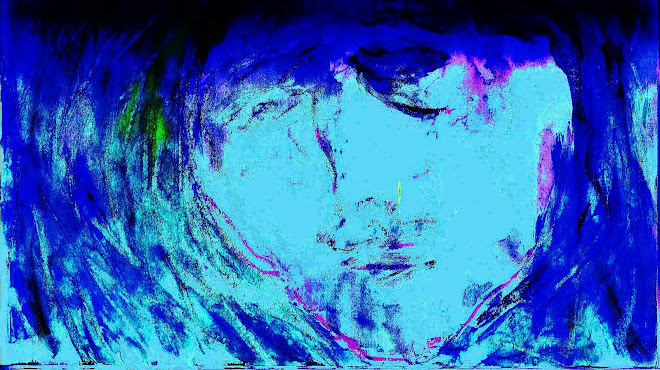
three falls
three crosses
Simon helps you
help thieves
help us
the shadow of your cross
reaches a cross
over all lands
in the garden of Gethsemane
doubt and fear
mingling
not lingering
you are comforted
accepting death
as your Father's will
accepting suffering
as your will for our salvation
we are comforted
Pilate's purpose
to wash his hands
only you and mother Mary
fully understand
Veronica
a veil
Joseph of Arimathea
a burial shroud
shrines for us to witness
taken back
our pain to God
vanquished
the fragile shroud
vanished
your suffering
taken back
Friday, April 22, 2011
Sunday, April 17, 2011
Chapter 43: Reed in His Right Hand
The crown of thorns is the mockery most noticed in the story of Christ's Passion. But what of the reed they placed in His right hand?
An instrument of irony. That reed, meant first to mock Christ as King, is the precursor to a second reed that is used to support a sponge soaked in wine and offered to Jesus before His very last breath.
The blood of a King that a King will not himself drink, but will spring forth and shower over all those who thirst.
Before the thorns, before the reeds, yellow-green palms ushered in our King.
On this sacred Sunday in Jerusalem, children weave waving palms into little baskets that carry flowers. On this sacred Sunday in Jerusalem, white sheets billow at the entrances of market stalls, burial shrouds of the surrendered-soon-to-be-risen King.
Should a loved one pass within this holy year, cover and bury the person with the sheet. Drape the person in the image of the one who makes a mockery of death every holy year.
This King, who forgives us the reeds of our shame. This King, who sits at the right hand of the Father.

Monday, March 28, 2011
Chapter 42: Death Birth
only one way to be born into this life
so many different ways to leave it
life mother womb conceives
blesses us with a savior
not knowing how
or the exact moment
the certain arrival of our death
encapsulates us with embryonic dread
suffering is our gestation
until death mother delivers us
womb to salvation
so many different ways to leave it
life mother womb conceives
blesses us with a savior
not knowing how
or the exact moment
the certain arrival of our death
encapsulates us with embryonic dread
suffering is our gestation
until death mother delivers us
womb to salvation
Saturday, February 26, 2011
Chapter 41: Passage
Imagine if you could perceive just one particle's worth of the love and joy that is God, knowing that you are only slightly scratching the surface of all that lies beyond (and simultaneously includes) your perceptions...
Just as unfathomable, imagine perceiving one particle of Christ's suffering as is evidenced on the Shroud and thereby comprehending the totality of suffering of mankind.
Each particle, of love (and of suffering), is energetically animated. Though we can intellectually, theoretically, and cognitively perceive the love and joy of God and, likewise, the suffering of Christ, on the energetic level we fall immeasurably short. Not our fault though, as we are limited by design (and simultaneously unlimited).
Is human suffering the primary portal to God's love? An opening to all encompassing divinity?
Our earthly, flat perceptions and our pain and suffering become the residue, the shadow that resides inside, the sprite clinging to its transparency.
Even if you could scratch that surface and know a love and joy so infinitesimal, one that shines brighter and stronger than seven suns, would you opt to release into it and leave your human life behind? Or would you take on a new understanding and appreciation for the worth of human existence?
What makes us cling to sorrowful human life when bliss awaits us?
Why does certain death, one that promises an end to suffering, inspire us to re-evaluate life's treasure trove?
As we catch that glimpse of eternal, omniscient joy, why do we back step into the monotony of day to day activities and concerns? Why don't we yearn forward?
There is no human fear that can come close to one particle of God's infinite love. So why do we fear and shun this love?
When someone dies or we look at old photographs of those from earlier times, we feel a drift of panic because we know at some point we too will not be included among the living. It's similar to the feeling of being left out as a child, when everyone else got to play outside and you had to stay inside.
When I was in Catholic grade school, one of the nuns read us a story about a planet where the sun would only shine one day a year. Every other day was gray and drenched in steady rains. The little girl at the center of the story was rapt with excitement for this upcoming day. Sure enough, the night before bullies locked her in a pitch black closet and she missed the entire day of light.
I remember feeling deep agony over the cruelty of those other children and a sorrowful disappointment that this girl missed the light. I don't remember how the sister interpreted the story, but I never forgot it.
I think it's about a lot more than cruelty. I think it's about hopes dashed and expectations vanquished...or how we let the darkness of human life overcome us and only value the light.
Human life is, perhaps, God's gift of passage, His opening, our way in. Without it we have no entry into His light.
Tuesday, February 1, 2011
Chapter 40: Trusting Peace
Lord, your peace holds all suffering
Faith is, presumably, based on trust. We can't fully have faith without trust. So then how is it that we waver, even for a moment, in trusting a man who sacrificed His life for our salvation? A man who suffered and endured relentless torture and pure evil on our behalf?
Is our doubt connected to our free will? Do we feel we are jeopardizing our free will when we release our lives and surrender our will to the will of God? When we offer up what is in our control, do we feel we have been undermined or duped? Is that why it is so hard for us to trust?
Is our doubt in unequivocal trust merely our free will exposing its deepest fear? Or is trust the only true and pure expression of free will?
Christ suffering, Christ dying – these were choices based on trust. It is wildly ironic that we marvel at His trust but doubt our own.
And still, in moments of our most dire suffering (individual or collective) we are surrounded, embraced, absorbed, folded into the gift of perfect peace. .. a gift that Christ earned for us through using His free will to surrender doubt and simply trust.
It is no wonder that some doubt that the image on the Sindone is an instrument of the trust Christ shrouds us with, enfolding us into His forever peace.
Friday, January 7, 2011
Chapter 39: Compressed Reality
The cloth of the Shroud and the image on the Shroud are two separate realities.
Microscopic images of the threads and fibers show us the multiple layers that make up the fabric that lies beneath the image. God is the omniscient transparency that constitutes and permeates every layer of scaffolding supporting the image resting on the fibrils.
In the image, an exponential compression of the energy that is God presents us with myriad complexities. It is as though we are being shown that God can expand and contract to levels far beyond what we can comprehend in this reality called human life.
It is comical to think that, among all the man made cathedrals and churches, statues and icons, just a scrap of cloth in the universal scheme of things was His chosen, fragile vehicle for ultimate power. His tortured imprint and the super-charged density of His resurrection remind us that suffering is frail and God's power is supreme.
Both the image and the cloth have been subjected to intense research, study, and scrutiny. Oddly, though, many people fixate on the carbon dating results of the cloth. Regardless if one is using those results to profess that the image is a fake or if one is arguing that the results are flawed, the age of the cloth remains the primary focus for many experts.
Let's assume the carbon dating results are valid and the cloth dates to the Middle Ages – how is that proof that the image is not that of the crucified Christ? That kind of logic would be similar to locking someone in a pitch black room and convincing the person that it is night time, when in actuality the sun is brightly shinning. We cannot manipulate time and reality to stop the sun from shinning simply by placing it in a context where it appears to be absent or by adamantly insisting that it is not shinning.
Likewise, even if we were able to prove beyond a shadow of a doubt that the carbon dating results are flawed and that the cloth does indeed date back to the first century, we still have no proof that the image is Christ's or any explanation for how it got onto the cloth.
Our human timeline is our tracking device for shaping our history. God has no history. His fabric always was and always is and always will be.
The cloth itself, no matter its age, is merely the proof that we have no proof. We only have the shinning sun of our freely chosen (or not chosen) faith.
Why do we compress reality by assuming that Christ wanted us to solve the mystery of the Shroud?
Perhaps He simply wanted to grace us with proof... that our faith reality (like His image on the cloth) is at once our vast mystery and the black hole density in His forever-never, simultaneously contracting and expanding schematic.
Saturday, January 1, 2011
Chapter 38: The Top of Happiness
In a kind of cause and effect way, we have sin to thank for salvation.
Someone had to save us from ourselves; Christmas brings us that someone.
Christ absolves all humanity through His suffering, death, Resurrection, and Ascension. But we remain imprisoned by our individual unhappiness as we make our weary way towards His gift.
We prefer to argue and disagree with each other about the existence and validity of salvation rather than commit to attaining it. Look at the controversy surrounding the Shroud if you need an example.
The beginning of a New Year is a well-timed event. What would it mean to each of us (and all of us) if we were to resolve ourselves to:
Reach in to the bottom of our unhappiness
Figure out once and for all what drives it, what feeds it
Absolve ourselves
Exchange ourselves to remedy it
Reach up to the top of our happiness
What if individual salvation was the collective New Year's resolution, our here-on-earth gift to ourselves and to God.
Subscribe to:
Posts (Atom)